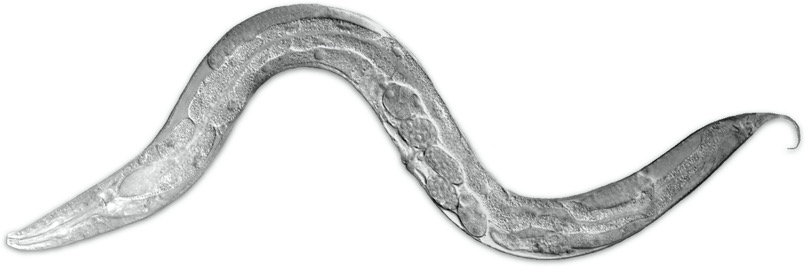
A C. elegans adult hermaphrodite imaged using Nomarski microscopy [Abbi Cox-Paulson].
C. elegans is a powerful model system for exploring the cellular mechanisms of early development, for several reasons:
(1) They're simple: The adult hermaphrodite has just a little over 1000 somatic nuclei (a few cells fuse together into multinucleate cells called syncytia). At the time most morophogenesis takes place, there are only several hundred cells in the embryo.
(2) They're transparent: Living C. elegans embryos can be imaged using Nomarski microscopy, or by imaging transgenic embryos expressing fluorescent proteins such as GFP.
(3) They're reproducible: Embryonic development is incredibly reproducible from embryo to embryo. Largely through the work of Nobel laureate John Sulston and colleagues, this allowed the determination of the complete lineage of every cell in C. elegans, i.e., the "history" of each cell in the embryo can be traced back to the one-celled zygote.
For more, see the WormAtlas and WormClassroom web sites. For some cool movies, see Bob Goldstein's movie repository (some of our stuff is there, too!).
C. elegans is a powerful model system for exploring the molecular mechanisms of early development as well, for several reasons:
(1) Genetics: Mutants can be isolated that have specific defects in development, and the mutated gene can be identified through positional cloning.
(2) Genomics/Proteomics: C. elegans was the first higher eukaryote whose genome was sequenced. As a result, there are a huge number of molecular reagents and bioinformatics tools available.
(3) Reverse genetics: RNA-mediated interference, or RNAi, was initially discovered in C. elegans. Worms can be injected with double-stranded RNA corresponding to a gene or fed bacteria that produce such RNA. The result is a knockdown of the function of that gene. RNAi clones spanning most of the genome are available for use in genome-wide screens.
For more, see WormBase.